

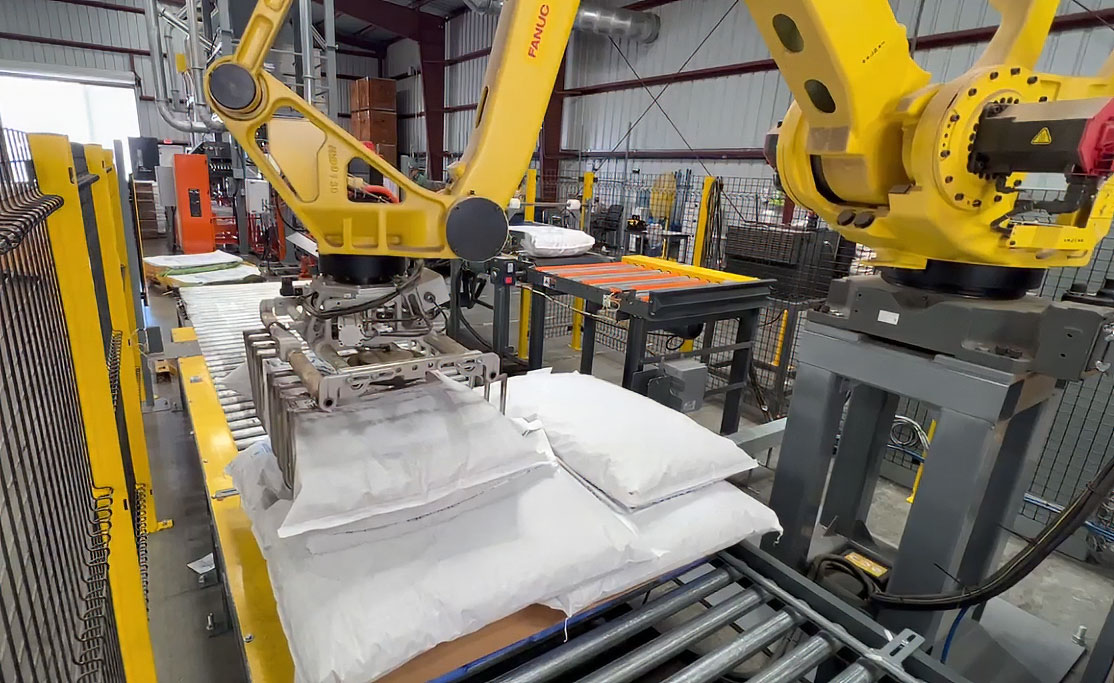
Automatic bag palletizing systems reduce manual lifting and help produce stable pallet loads. Options range from an entry-level gantry palletizer to an integrated robotic system that dispenses empty pallets, stacks bags, and conveys completed loads through an automatic stretch wrapper.
Packaging products in open mouth bags or valve bags? The correct solution depends on production rate, bag characteristics, available floor space, and how much of the palletizing process you want to automate at a budget that makes sense.
Compare Four Options
Below are four common configurations, arranged from lower to higher relative cost.
| Palletizing option | Relative cost | What is automated? | Routine operator involvement |
|---|---|---|---|
| Gantry palletizer | Low | Bag pickup and stacking | Remove full pallets and position empty pallets |
| Reconditioned FANUC robot with side-by-side stacking | Low-to-Medium | Bag pickup and stacking in two pallet positions | Exchange pallets in the available stacking zone |
| Robot that also places pallets and slip sheets | Medium | One robot handles bags, pallets, and slip sheets; powered pallet discharge can be included | Replenish supplies and retrieve completed loads; wrapping may take place separately |
| Fully automated robotic palletizing system | Higher | Robot stacks bags while dedicated equipment dispenses pallets; pallet conveying, slip sheet application, and wrapping can be integrated | Replenish supplies, monitor operation, and retrieve finished pallets |
Cost levels compare these configurations with one another. Actual project costs can overlap depending on capacity, conveyors, tooling, layout, and selected options. *** A quick phone call or online meeting will help to determine a good budgetary number.
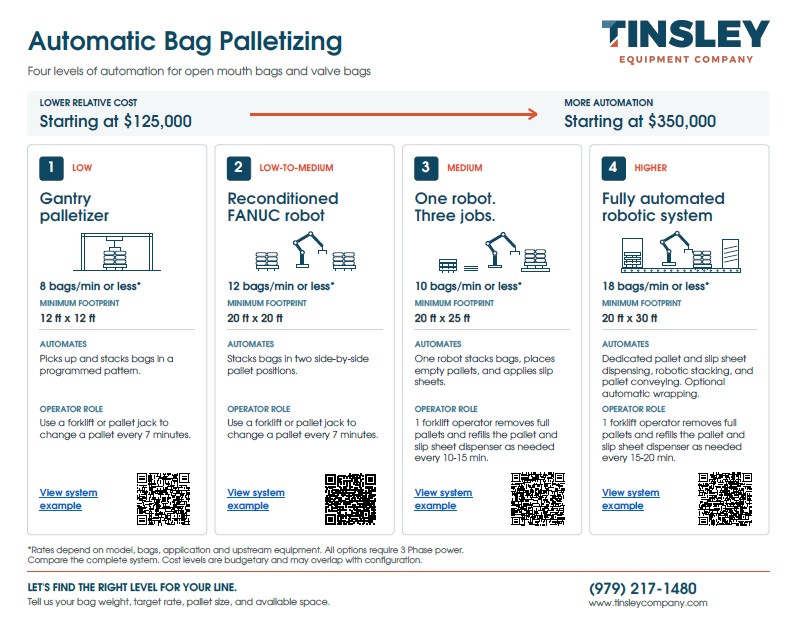
Click the thumbnail to open a printer-friendly / downloadable PDF
Ask a Question -or- Get a Price Quote
Call: 979-217-1480

1. Gantry Palletizer Systems
Relative cost: Low (starting at $125,000*)
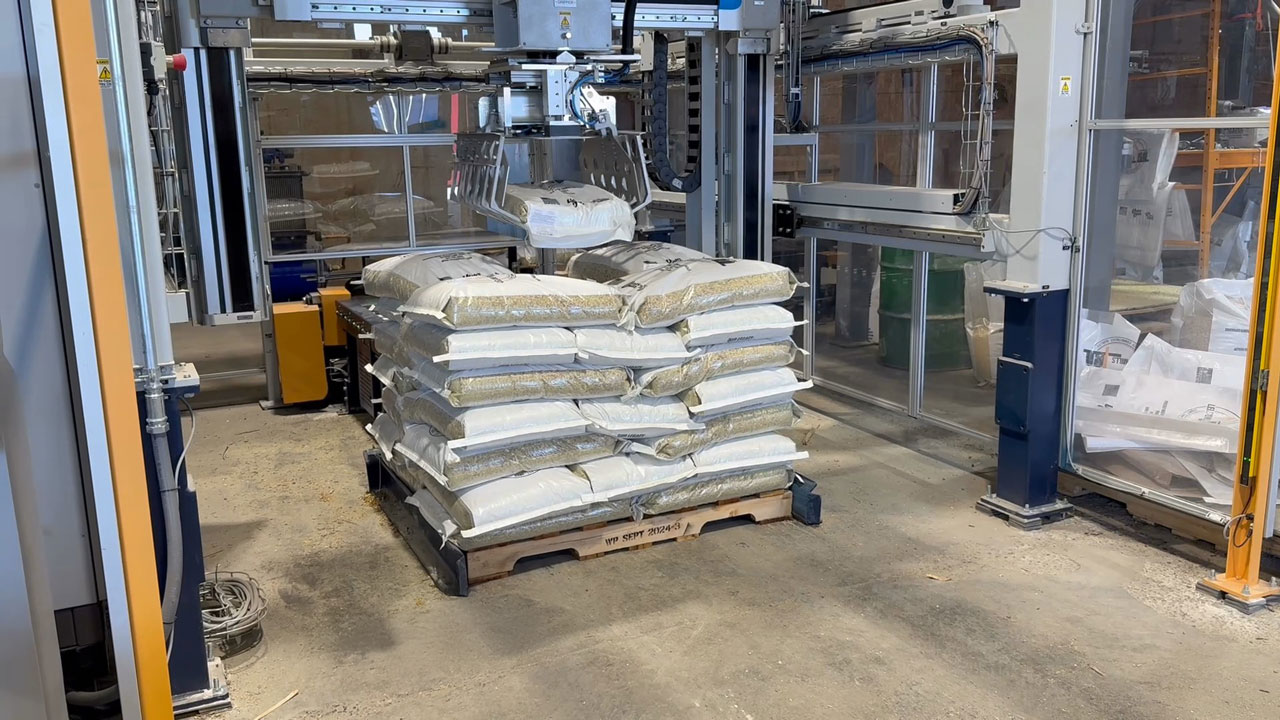
A gantry palletizer is an affordable starting point for automating bag stacking. A gripper travels within the gantry framework, picks up filled bags from an infeed conveyor, and places them on a pallet in a programmed pattern.
This type of entry-level gantry palletizer system can stack up to 8 bags per minute, depending on the model and application. The minimum footprint for this type of bag palletizing system is 12 ft x 12 ft and requires 3 Phase power.
Touch-screen controls allow operators to select stored stacking recipes. These systems can be particularly useful for heavy, loose or floppy bags containing products such as feed, seed, sand, aggregate, or agricultural products like onions. Once a pallet is complete, an operator using a forklift or pallet jack removes it from the bag stack zone and positions an empty pallet for the next load approximately every 7 minutes.
A good fit for: Operations that want to eliminate repetitive bag lifting while continuing to handle pallet changes with a forklift or pallet jack.
For a specific example, see the SentryStack automatic bag palletizer, a compact gantry-style system rated up to 8 bags per minute.
* Budgetary pricing as of fall 2026. Compare the complete system. Cost levels are budgetary and may overlap with configuration.
2. Reconditioned FANUC Robot with Side-by-Side Pallet Stacking
Relative cost: Low-to-Medium (starting at $199,500*)
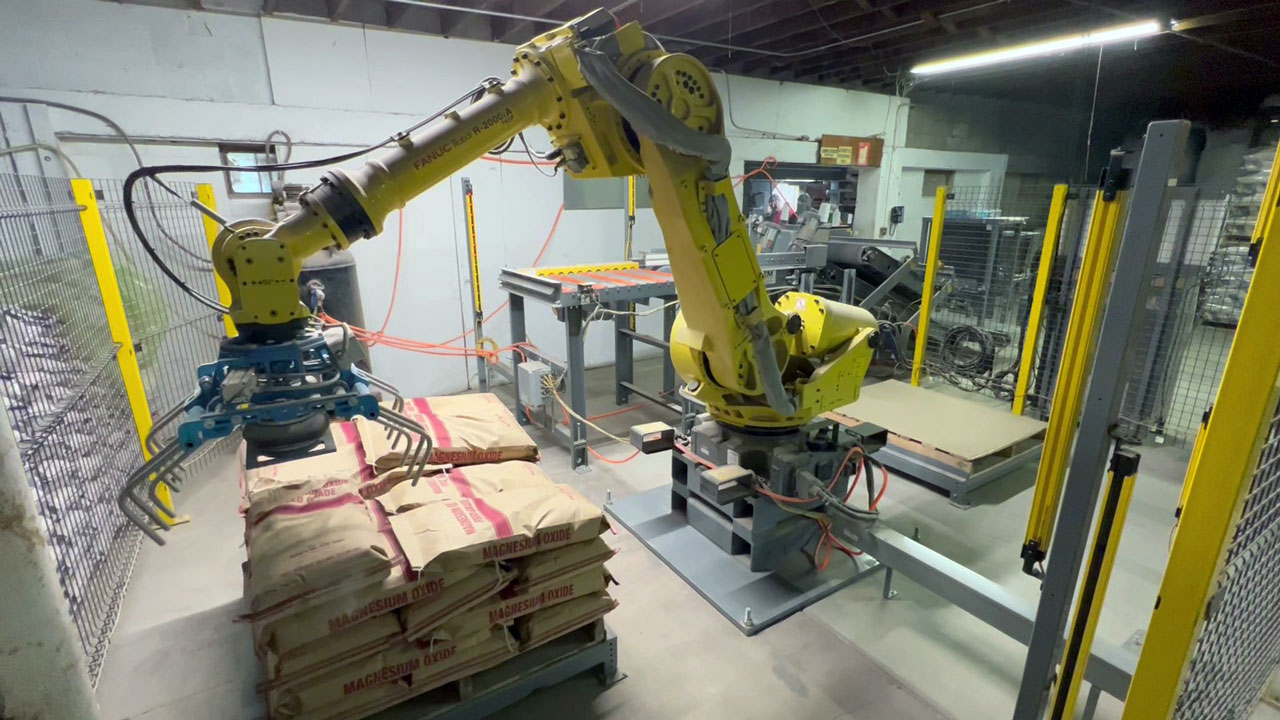
A reconditioned FANUC robot offers another way to automate stacking while controlling equipment costs. The palletizing robot arm uses a bag gripper to transfer filled bags from a pick conveyor to one of two pallet positions on the floor at a rate of 12 bags per minute or less. The minimum footprint for this type of bag palletizing system is 20 ft x 20 ft and requires 3 Phase power.
In a side-by-side arrangement, the robot finishes one pallet and switches to the other position. An operator using a forklift or pallet jack removes the completed load and places an empty pallet in the available zone approximately every 7 minutes. Safety controls coordinate access and robot movement between the two zones.
Our single or dual stack robotic bag palletizers are generally recommended for bagging lines running at 12 bags per minute or less. Required performance is evaluated using your bags, weights, and stacking pattern.
A good fit for: Existing bagging lines that need automatic stacking and have forklift support available for pallet changes.
See a robot stacking 50 lb. bags on two pallets or learn more about our reconditioned robotic palletizers.
* Budgetary pricing as of fall 2026. Compare the complete system. Cost levels are budgetary and may overlap with configuration.
3. Robot That Stacks Bags, Places Pallets, and Applies Slip Sheets
Relative cost: Medium (budget range $215,000 – $250,000*)
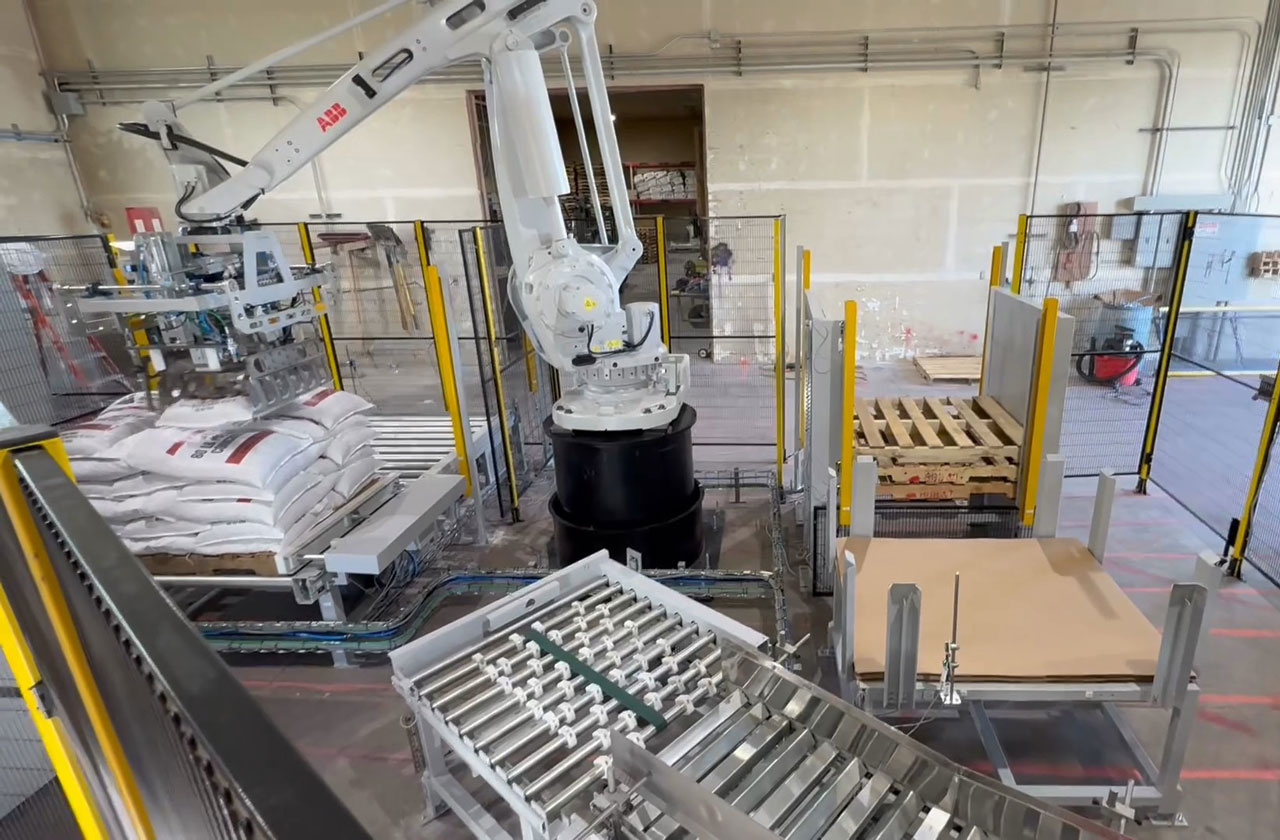
This configuration uses one robot with a multifunction tool to stack filled bags, position empty pallets, and apply slip sheets at a rate of about 10 bags / minute or less. It automates pallet preparation along with the heavy lifting involved in bag stacking. The minimum footprint for this type of bag palletizing system is 20 ft x 25 ft and requires 3 Phase power.
Our ABB bag palletizing installation for a concrete and mortar mix producer illustrates this approach. The system handles 80 lb. open mouth poly-woven bags and was added after the company’s existing bag filling and sewing equipment in a compact layout.
The robot’s tool performs three jobs:
- A pallet gripping mechanism lifts an empty wooden pallet from a nearby stack and places it on the palletizing conveyor.
- Suction cups lift a paper slip sheet from a separate stack and place it on the pallet.
- A bag gripper picks up filled bags and stacks them in a programmed pattern.
In this installation, powered rollers discharge each completed load onto a full pallet accumulation conveyor. A forklift operator retrieves it and takes it to a separate stretch wrapper. Operators also replenish the empty pallets and slip sheet stacks in the magazines approximately every 10-15 minutes.
Because the robot performs several tasks, the system must allow time for pallet and slip sheet placement as well as bag stacking. Its overall production rate should be evaluated across the complete pallet cycle.
A good fit for: Operations that want to automate pallet preparation along with bag stacking and whose production rate suits a robot performing all three tasks.
* Budgetary pricing as of fall 2026. Compare the complete system. Cost levels are budgetary and may overlap with configuration.
4. Fully Automated Robotic Palletizing Systems
Relative cost: Higher (starting at $350,000*)
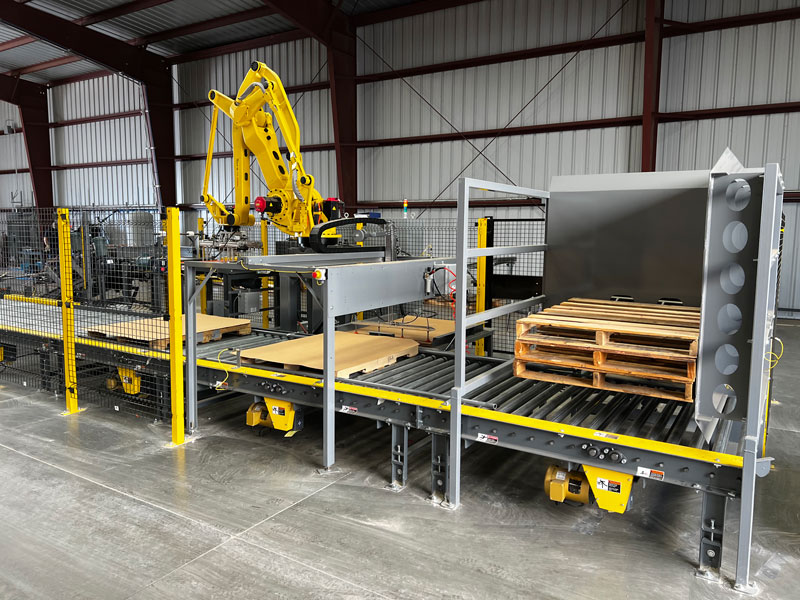
At this level, a dedicated pallet dispenser supplies empty pallets, and a separate applicator places slip sheets when required. These devices handle pallet preparation while the robot focuses on stacking bags at a rate of 18 bags / min or less. Powered conveyors move pallets through the system, with automatic wrapping available to complete the line. A typical configuration requires 3 Phase power and includes:
- A robotic arm with a bag gripper and programmed stacking patterns.
- An automatic pallet dispenser that feeds empty pallets into the line.
- A slip sheet applicator when sheets are required.
- Powered conveyors for pallet positioning, discharge, and accumulation.
- An optional automatic stretch wrapper for securing completed loads.
This configuration has a minimum footprint of 20 ft x 30 ft and supports higher production rates, but it can also make sense for heavier bags at moderate speeds. One system handling 100 lb. paper valve bags combines a reconditioned FANUC robot with automatic pallet and slip sheet dispensing. That installation uses a separate heat shrink wrapping step.
For an example with integrated wrapping, see this 40 kg livestock feed bagging and palletizing system. You can also view an automatic pallet dispenser with slip sheet applicator or a complete automated bagging and palletizing line.
A good fit for: Operations seeking higher throughput, fewer individual pallet handling tasks, or an integrated path from bag stacking to wrapped pallet discharge.
* Budgetary pricing as of fall 2026. Compare the complete system. Cost levels are budgetary and may overlap with configuration.
Which Automatic Palletizing Option Fits Your Operation?
Start with the tasks you want to automate and the production rate you need to maintain. To help compare configurations, tell us:
- Your product, bag type, filled bag dimensions, and weight.
- Your current and target production rates in bags per minute.
- Your pallet dimensions, stacking pattern, and finished load height.
- Your available floor space and existing bagging equipment.
- Whether you need automatic pallet placement, slip sheets, or wrapping.
You do not need to select a robot or finalize the layout before contacting us. Tinsley Equipment Company can help compare practical options for your application and budget.
Ask a Question -or- Get a Price Quote
Call: 979-217-1480