

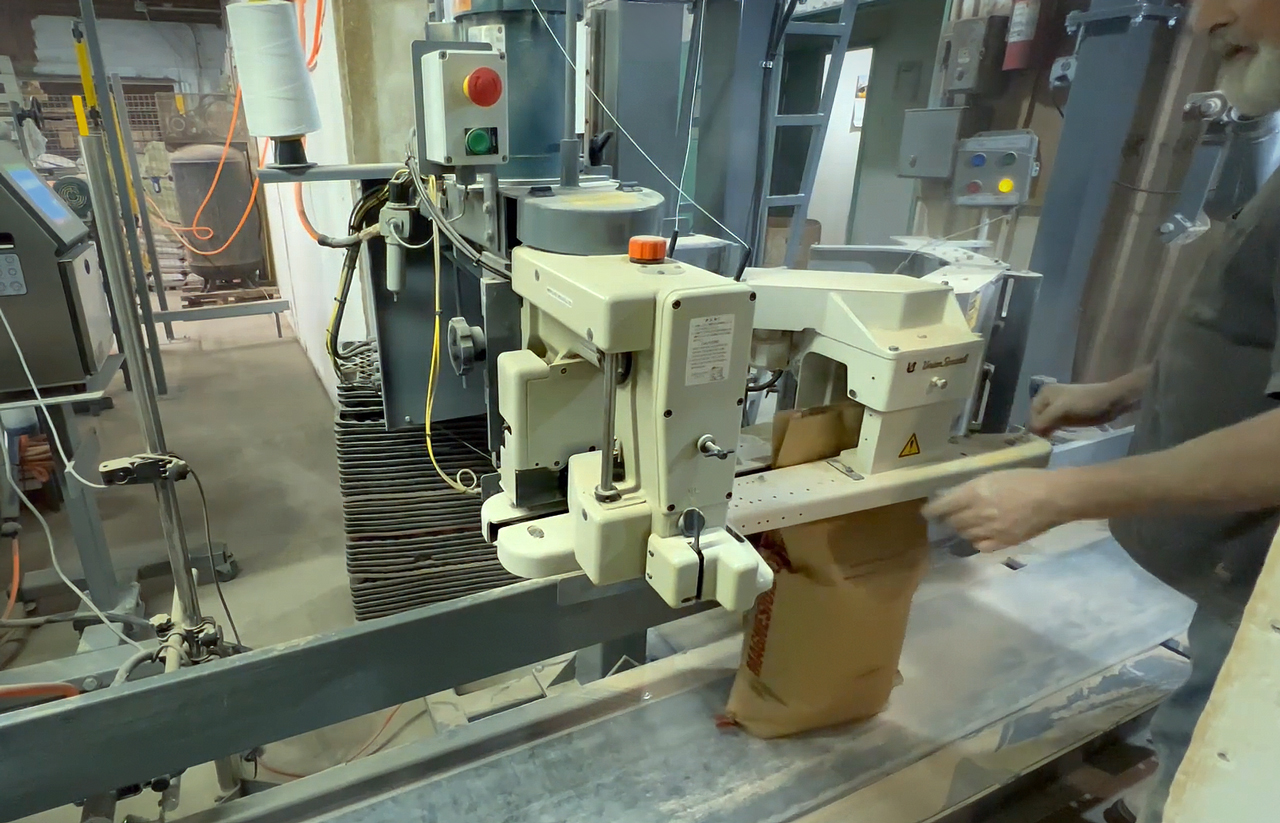
Pedestal-mounted industrial bag sewing systems combine a sewing head, adjustable pedestal, and bag closing conveyor to close filled open mouth bags. Depending on the configuration, controls automatically start and stop sewing, cut thread, and operate a powered infeed that guides the bag top through the sewing area.
These systems can close suitable paper, plastic, poly-woven, and BOPP bags. The sewing head and closure arrangement should be selected for the bag construction and application.
These systems are commonly used for animal feed, corn, seed, grain, and other agricultural products. They also serve food, chemical, powder, and other processing operations. The right setup depends on your bag construction, production rate, closure requirements, and how much bag handling you want to automate.
Compare Four Options
Below are four common options for bag sewing machines arranged from lower to higher relative cost. A hand-held machine provides the starting point, with conveyor-based systems offering progressively more support and control over the closing process.
| Sewing option | Relative cost | What is automated? | Routine operator involvement |
|---|---|---|---|
| Hand-held bag sewing head | Low | Powered stitching and thread cutting | Prepare the bag top and manually guide the sewing head across it |
| TitanStitch4 bag sewing system | Low-to-Medium | Bag conveying and wand-controlled sewing start/stop | Prepare and guide bag tops into the pedestal-mounted sewing head |
| Industrial sewing without a powered infeed | Medium | Bag conveying and wand-controlled sewing start/stop; thread handling depends on configuration | Prepare and feed bag tops into the industrial sewing head |
| High-speed sewing with a powered infeed | Higher | Bag conveying, powered bag-top feeding, sewing start/stop, and cutting; folding or taping can be included | Prepare and feed bag tops into the automatic powered infeed; monitor operation and replenish supplies |
Closing rates depend on the sewing head, bags, closure type, and upstream equipment. Compare the complete system and utility requirements when evaluating configurations.
Cost levels compare these configurations with one another. Actual project costs can overlap depending on the sewing head, pedestal, conveyor, controls, and selected options. A quick phone call or online meeting can help determine an appropriate budget range.
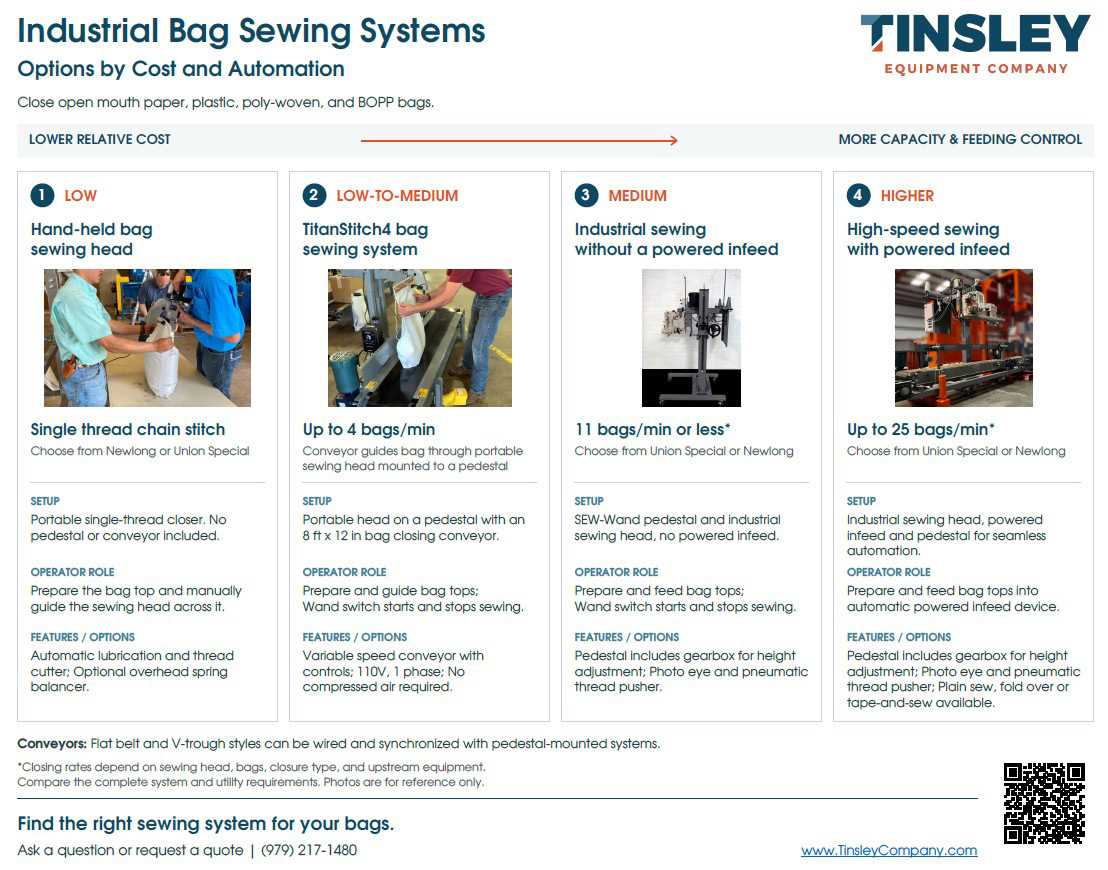
Click the thumbnail to open a printer-friendly / downloadable PDF
Ask a Question -or- Get a Price Quote
 Call: (979) 217-1480
1. Hand-held bag sewing heads
Relative cost: Low (starting at $650*)
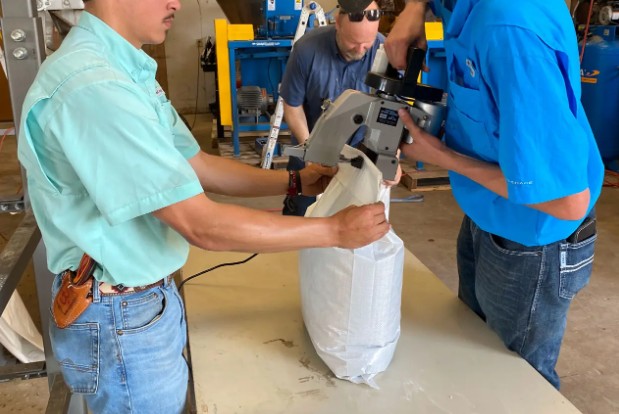
Hand-held bag sewing heads are the lowest-cost option in this comparison, with choices from Newlong and Union Special. The operator prepares the filled bag’s top and manually guides the sewing head across it to produce a single-thread chain stitch.
The Newlong NP-7A is one example. This portable closer can sew suitable paper, plastic, and poly-woven bags and includes automatic oil-pump lubrication and an automatic thread cutter. Features depend on the selected model. No pedestal or conveyor is included in the basic hand-held package.
An optional overhead spring balancer supports the sewing machine and gently retracts it overhead between bags. This can be very helpful because these types of sewing heads with cones of thread weigh around 15 lbs. Production depends on the operator, bag characteristics, and the complete filling and closing cycle.
A good fit for: Operations that need portable bag closing for manual bagging, occasional production, or use in different locations.
For a specific example, see the Bagging Horse Pellets into 25 lb Bags case study article.
* Budgetary pricing as of fall 2026. Compare the complete system. Cost levels are budgetary and may overlap with configuration.
2. TitanStitch4 bag sewing system up to 4 bags/min
Relative cost: Low-to-Medium (Entire system starting at $10,000*)
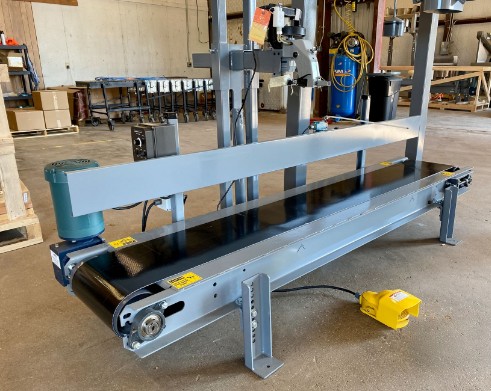
The TitanStitch4 bag sewing system mounts a portable sewing head on an adjustable pedestal above a bag closing conveyor. It is intended for a single operator closing open mouth bags at rates of up to 4 bags per minute.
The variable speed conveyor guides the filled bag through a portable sewing head mounted to an adjustable pedestal. The operator prepares and guides the bag top into the sewing area, and a wand switch starts and stops sewing as bags pass through. This arrangement supports a straightforward closing process for bags.
The system includes:
- An 8 ft long by 12 in wide bag closing conveyor
- Adjustable conveyor height of 18-21 in and an adjustable back rail
- A variable speed conveyor with controls and wand-controlled sewing start/stop.
- A portable sewing head with an adjustable mounting pedestal.
- 110 V, single-phase, 60 Hz electrical service.
- Operation without compressed air.
The mounted head eliminates the need to carry the sewing machine across each bag. It can also be used as a portable machine when needed. Applications extend beyond agricultural products to suitable powders and other materials packaged in sewable open mouth bags.
A good fit for: A single-operator bagging line that needs a bag sewing machine with a conveyor and a closing rate of up to 4 bags per minute.
For a specific example and more information, see the Bagging Deer Corn and Other Grains into 30 lb to 50 lb Bags article.
* Budgetary pricing as of fall 2026. Compare the complete system. Cost levels are budgetary and may overlap with configuration.
3. Industrial sewing without a powered infeed 11 bags/min or less
Relative cost: Medium (Pedestal only starting at $22,290*)
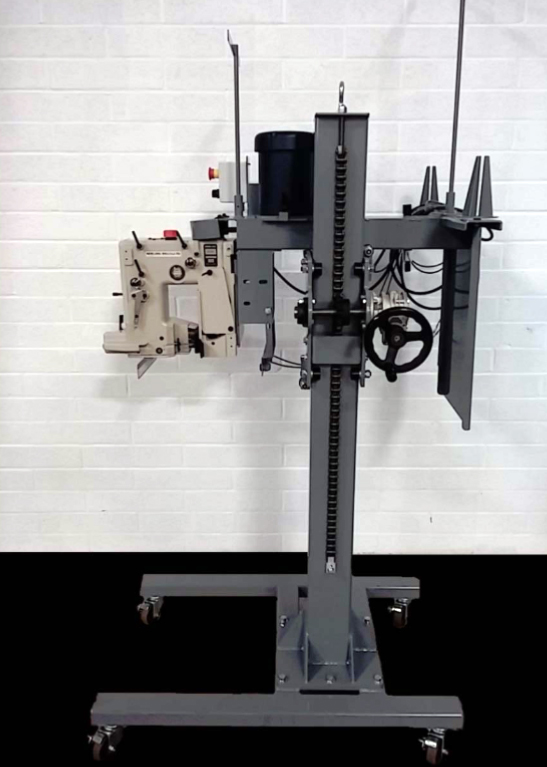
An industrial sewing head on a SEW-Wand pedestal provides another option for production lines. This arrangement uses a more economical industrial pedestal and relies on the operator to prepare and feed the bag top into the sewing head. It does not include a powered bag-top infeed assembly.
Available sewing heads include the Newlong DS-2 and Union Special 8800CN. A wand switch starts and stops the sewing head as bags pass through the sewing head. The pedestal has gearbox-operated height adjustment, and its fixed-speed sewing setup works with a variable-speed bag closing conveyor (conveyor sold separately).
Photo-eye controls and a pneumatic thread pusher are also included. The thread pusher directs the thread chain into the knife and requires compressed air. The wand switch, photo eye, and cutter controls should be specified to suit the selected sewing head and closing arrangement.
One conveyor configuration includes an 8 ft long by 12 in wide flat belt conveyor with a back rail and controls. Conveyor lengths and shapes depend on the distance to travel from the bag filling machine, through the sewing head, and to downstream parts of the system.
For feed, grain, food, chemical, and other processing lines, this setup provides industrial sewing capability while retaining manual bag-top feeding. The sewing head and conveyor should be matched to the bag construction and required production rate.
A good fit for: Operations that need an industrial sewing pedestal but can continue using an operator to guide bag tops into the sewing head.
See our Bag Sewing Machines equipment page for more information about high-speed bag sewing machines and closers.
* Budgetary pricing as of fall 2026. Compare the complete system. Cost levels are budgetary and may overlap with configuration.
4. High-Speed Bag Sewing System With Powered Infeed
Relative cost: Higher (Pedestal only starting at $28,490)
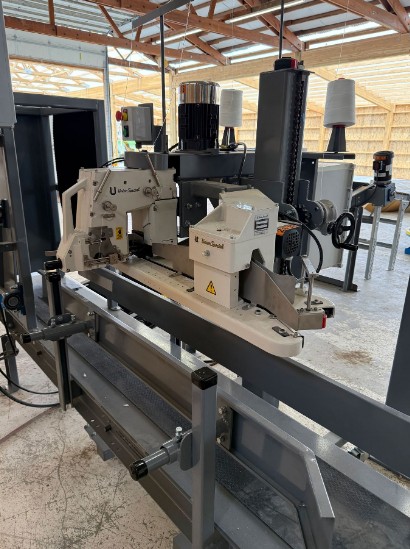
At this level, a powered infeed grips and guides the bag top safely through an industrial sewing head. A synchronized bag closing conveyor (sold separately) supports and moves the filled bag below. This arrangement provides more controlled feeding for higher production rates and additional closure options.
Selected configurations using the Union Special BC211UA23-1NW sewing head are capable of up to 25 bags per minute. Actual line performance depends on bag dimensions, spacing, closure style, and how consistently bags arrive at the sewing pedestal.
A configured system can include:
- An industrial sewing head with a guillotine-style thread cutter.
- An adjustable pedestal or column.
- Start/stop photo eyes and thread cutter controls.
- A powered infeed with its motor and controls.
- Variable-speed drives to coordinate equipment operation.
- A matched bag closing conveyor (sold separately).
The closure can also be selected for the application:
- Plain sew: Stitches across the prepared bag top.
- Fold-over and sew: Folds the bag top before stitching.
- Tape and sew: Applies tape over the bag top and stitches through the closure.
These types of setups offer additional pedestal, column, and infeed combinations. Depending on the selected package, tape-and-sew equipment may include a bag-top trimmer, tape folder, reel holder, and trim-removal components.
Automatic bag sewing systems still require attention to bag presentation. An operator prepares and introduces bag tops unless additional equipment performs those tasks. A powered infeed controls feeding through the sewing head. Additional automation requires integration with the upstream bagging and bag-top handling equipment.
A good fit for: Production lines seeking higher closing rates, more consistent bag-top feeding, or fold-over and tape-and-sew closure options.
For an example, see the video shown in the Packaging and Palletizing Line for Bags of Supplements article.
* Budgetary pricing as of fall 2026. Compare the complete system. Cost levels are budgetary and may overlap with configuration.
Match the Sewing System to the Bag Closing Conveyor
The conveyor is an important part of a pedestal-mounted bag sewing system. It must support the filled bag and move it through the closing area at a speed that works with the sewing head and any powered infeed.
Tinsley supplies flat belt and V-belt (V-trough) bag closing conveyors that can be wired and synchronized with these bag sewing systems. Flat belt conveyors support bags from below, while V-trough conveyors cradle bags to help maintain an upright position.
The TitanStitch4 package includes its conveyor. Conveyor scope for larger systems depends on the configuration, so compare the complete package when evaluating options.
Learn more about our bag closing conveyors and industrial bag sewing equipment.
Which Industrial Bag Sewing System Fits Your Operation?
Start with the production rate you need and the bag handling tasks you want to automate. To help compare configurations, tell us:
- Your product, bag material, filled bag dimensions, and weight.
- Your current and target production rates in bags per minute.
- Whether you need plain sew, fold-over, or tape-and-sew closures.
- How operators currently prepare and feed bags into the closing equipment.
- Your available space, existing conveyor, electrical service, and compressed air.
Photos of your existing line and samples of your bags also help us evaluate a suitable configuration.
Whether you are closing bags of animal feed and corn or packaging food ingredients, chemicals, and powders, you do not need to select a sewing head or finalize the conveyor arrangement before contacting us. Tinsley Equipment Company can help compare practical options for your application and budget.
Ask a Question -or- Get a Price Quote
Call: (979) 217-1480